TikTok Ad Creative Best Practices for 2026 (What the Algorithm Rewards)
I run a platform that lives and dies by performance creative. TikTok rewards native energy: fast hooks, clear benefits, human presence, and watchable pacing. The polish arms race from other channels does not carry here; it often hurts. Below are the TikTok ad creative best practices we use across accounts, what the algorithm seems to value in 2026, and the exact checks we run before pushing spend.
What the TikTok algorithm actually rewards (observed vs folklore)
TikTok’s ad delivery prioritizes signals that look a lot like For You feed success: did people stop, did they keep watching, did they interact, and did they act. Thumbstop in the first two seconds matters because it sets the bid landscape for your CPM; if you fail to hook, everything downstream gets expensive. Watch time and replays correlate with scale; loops and fast cuts that invite a second view still improve odds. Comments, shares, and saves punch above their weight, especially on Spark placements where social proof carries forward.
Conversion signals still decide winners in paid, but you typically won’t brute-force a weak creative with bid. A high CTR with poor hold time almost always burns budget; TikTok optimizes toward scroll happiness first. That is why clarity beats mystery: state the problem and benefit early, then earn retention with pattern shifts, on-screen text, and real product usage. You can be scrappy, but you cannot be boring.
Native beats polish, clarity beats tease, and momentum beats perfect pacing.
Format fundamentals: film like a TikTok, not like a TV spot
TikTok is 9:16 first. Fill the frame vertically, keep key text inside a safe zone to avoid UI overlays, and assume viewers are one thumb away from leaving. We place titles and CTAs above the lower 15% and below the top 12% of the frame to dodge the caption and top bar. Left/right margins matter less than vertical margins on most devices, but we still avoid hugging edges with tiny text.
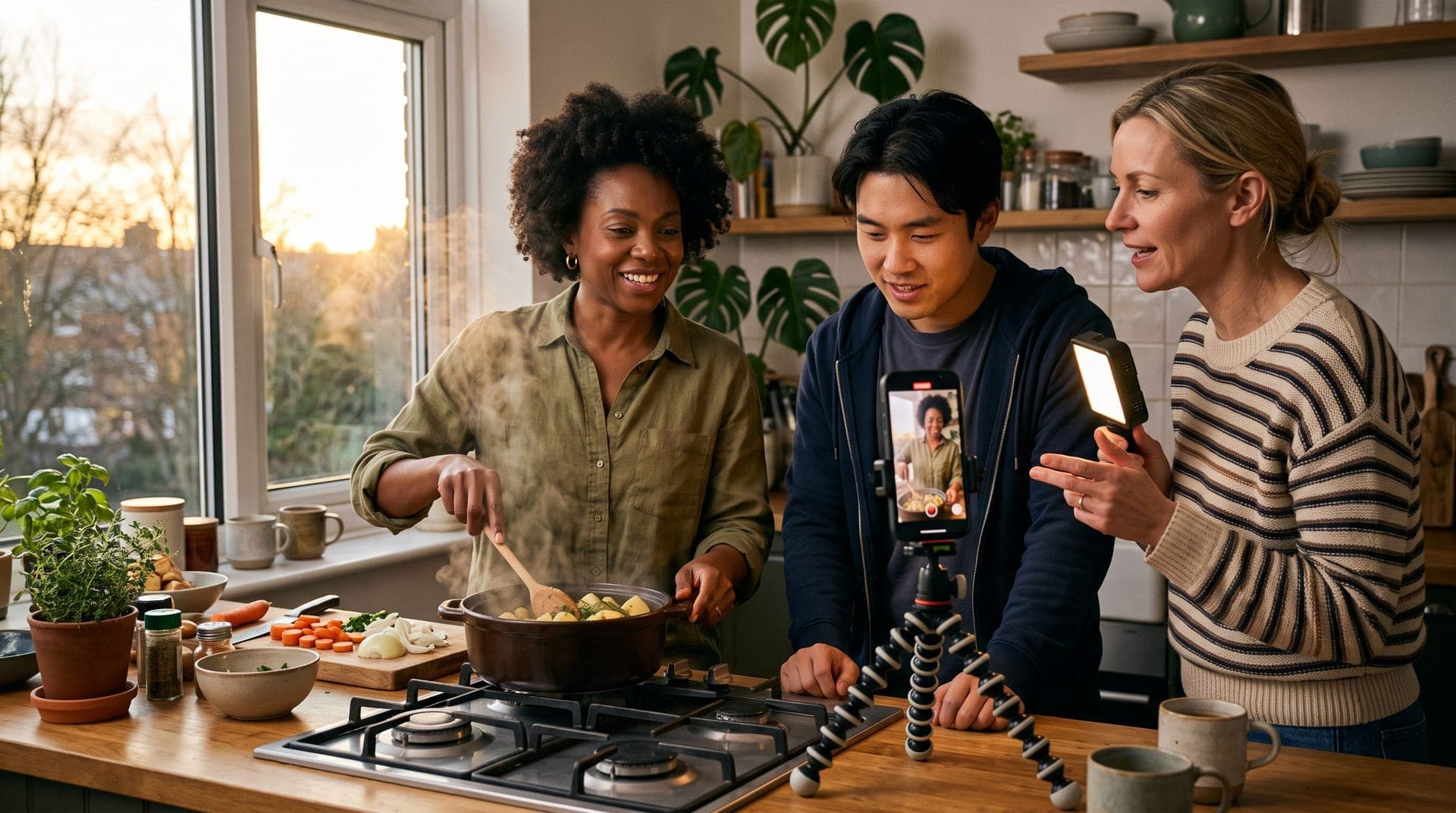
Shoot with a phone, hand-held or on a small tripod, and let environmental texture live. Over-produced lighting and studio mics can work if the content is loud enough conceptually, but it often reads like an ad and gets swiped. Face-forward delivery paired with B-roll of the product in action remains the highest percentage move for DTC, apps, and SaaS. Keep transitions functional; wipe, snap, jump cut, speed ramp — pick one and move on.
Captions for sound-off and scanning
A growing share of users watch with sound low or off, and even sound-on users scan first. Burnt-in captions or on-screen text summaries make your message resilient. We highlight 3-5 keywords in each beat rather than subtitle every syllable; it’s faster to parse and helps scanning viewers decide to stay. TikTok’s auto-captions have improved, but we still export or burn-in captions to control timing and emphasis.
Sound design and voice
Voiceover or to-camera delivery should be punchy and dry of reverb; kitchens and bathrooms echo, so step back from hard tiles or throw a towel on counters. Background music should be a bed, not a lead; set voice clearly above it and cut whenever the music fights with a callout. Use trending sounds carefully on ads — rights are different from organic. When in doubt, pick platform-cleared tracks and let your words do the selling.
The two-second hook: engineering the thumbstop
Those first two seconds decide if the ad gets a chance. Use a visual or verbal disruptor that sets the problem and stakes immediately. If the viewer can’t tell what the video is about by second two or three, expect low hold and high CPMs. There is no universal magic line, but there are reliable patterns.
Hook patterns that keep working in 2026:
- Direct pain callout: “If your [pain] looks like this, watch this.” Show the pain visually at the same time.
- Time-bound promise: “Give me 15 seconds — I’ll show you the fastest way to [result].” Then deliver quickly.
- Comparison/dupe: “I stopped buying [X] after I tried this.” Cut to product in hand.
- Micro-story cold open: Start mid-action with a surprising visual, then explain.
- Counterintuitive rule: “Stop doing [common habit]. Do this instead.” Teach the fix immediately.
If you want ready-to-go lines for each vertical, I put my favorites in our free UGC ad script templates. Use them as a starting point, then adapt to the exact objection your audience carries.
Structure and pacing: get to the point, then keep moving
TikTok rewards motion and novelty. We build most ads in 12–28 seconds, with a front-loaded benefit and one controlling idea. The average viewer will grant you one beat per second, so we script in beats: hook, problem visual, product in action, proof, CTA. Keep each beat distinct with a cut, angle change, or text shift; if two adjacent shots look similar, you lose momentum.
On-screen text should ladder the story. Use short lines that land in rhythm with the cut: four to six words per card is enough. If you must teach something complex, show it physically while a clean subtitle sums it up. End on an explicit action: tap to claim, start free trial, shop the bundle — not just a brand name.
Native-feeling footage beats polish (and how to still look good)
Everyone says “shoot native,” but here is what that means in practice. Use a phone rear camera, natural light from a window, and everyday settings: kitchen counter, car cup holder, gym bench, messy desk. Imperfections like a slightly off-center frame or a hand in the shot help it read feed-first. What kills native vibe is ad tells: perfect product packshots, slow dolly moves, corporate voiceovers, and stock-model smiles.
When you need polish, put it in the subject matter, not the set. A satisfying demo, a clean close-up of a texture, an over-the-shoulder screen recording cropped for 9:16 — those add clarity without screaming “ad.” Keep brand marks minimal and well-placed. One logo in the final two seconds is plenty; the rest of the work should be done by the problem/solution sequence and on-screen value.
Spark Ads vs. regular TikTok ads: when to use each
Spark Ads let you promote a real post from a creator or your brand account, bringing comments, likes, and shares along. They look the most native, they can redirect to profile as well as to a landing page, and they tend to collect better social proof over time. If you partner with creators or already have organic momentum, Spark is an easy lift. The trade-off is less granular copy iteration and dependency on the post’s handle and comments environment.
Regular (non-Spark) ads give you full creative control and cleaner A/B testing. You can rapidly vary hooks, overlays, and CTAs without chasing post authorizations or worrying about comment carryover. For hard offers, time-sensitive sales, or complex compliance, non-Spark is simpler. The hybrid approach works best at scale: test fast with non-Spark, then port winners to Spark via creator whitelisting to harvest social proof.
Creative fatigue and refresh cadence
Even the strongest creative decays. Watch for three early fatigue signals: a rising CPM as your thumbstop weakens, falling 2–3 second hold, and CTR decline at stable spend. CPA often lags those signals, which is why many teams refresh too late. Build a cadence that assumes decay and rotates hooks before the drop is obvious.
Here is a practical cadence for 2026:
- Launch 3–5 hooks per concept in week one and let them fight. Small changes in the opening line or visual can swing hold time by double-digit percents.
- Keep the body constant while swapping only the first 3–5 seconds until you see a clear hook winner.
- At scale, add 1–2 new hooks per ad set every 3–4 days. For lower spend, weekly is fine.
- When a concept fatigues across hooks, retire the angle and build a new controlling idea (different pain, different proof, different demo).
If you need a testing framework with kill rules and budgets, I wrote a full breakdown here: How to test ad creatives in 2026. Use that to keep discipline when a pet concept emotionally feels like it should win.
Compliance: the most common rejection reasons on TikTok
TikTok is strict on safety, realism, and claims. The fastest ways to get rejected are unsubstantiated outcome promises, before/after transformations (especially weight loss and medical), dangerous acts, minors in adult contexts, and restricted goods. Medical and financial verticals should avoid outcome guarantees, testimonials that imply guaranteed results, or visuals that could be interpreted as diagnosis or treatment. If your product touches body image, avoid zooming on specific anatomy or heavily suggestive framing.
Other easy tripwires: counterfeit or lookalike claims, referencing TikTok’s brand or UI in a way that implies endorsement, excessive gore or shocking content, and region-specific alcohol/vaping rules. Keep overlays clean of profanity or baiting language. And do not use watermarked third-party footage — that alone can fail a review. When in doubt, simplify language, focus on product use, and add a soft disclaimer if you’re skirting a regulated space.
The pre-flight checklist (run this before you submit)
This is the exact pre-flight we run internally. It prevents 80% of wasted reviews and most preventable underperformers. Assign an owner and check the boxes.
| Item | Why it matters | How to check |
|---|---|---|
| 9:16 full-frame | TikTok is vertical; pillarboxing kills immersion | Inspect export: 1080x1920 or 2160x3840, no black bars |
| Safe text zones | Avoid UI overlap on top/bottom | Keep key text 12% from top, 15% from bottom |
| Hook lands by 0:02 | Thumbstop determines CPM and scale | Play first 2 seconds with sound off — is the topic obvious? |
| Product visible by 0:03 | Early clarity boosts hold | Freeze at 0:03 — can you see or infer the product? |
| Sound-off readable | Many users watch muted | Burnt-in captions or bold on-screen text covering each beat |
| Pace every 0.7–1.2s | Momentum keeps retention | No two adjacent shots look identical; text changes with cuts |
| Clear benefit copy | Scannable value drives clicks | One-sentence benefit appears by 0:05 in text or VO |
| Legal/claims scrub | Avoid rejections | Remove guarantees, before/after, restricted terms; add disclaimers as needed |
| Brand presence light | Native feel > heavy branding | Max one logo end card; no watermarks |
| CTA explicit | Direction beats brand recall | Final 2–3 seconds: verb + object + urgency (e.g., “Start free trial”) |
| Color/subtitle contrast | Accessibility and speed | White text with dark stroke or high-contrast box; readable on mobile |
| Audio balance | Voice over music | Voice clear and forward; no clipping or pumping |
| Thumbnail frame | First frame matters | Select a frame that telegraphs the topic without text |
| File size/codec sanity | Upload reliability | H.264/H.265, under ~100MB for short spots, 24–30fps |
| Spark toggle chosen | Distribution strategy | Decide Spark vs non-Spark before export to match caption style |
| Landing page scent | Post-click congruence | Same promise/visuals on LP hero as in the ad |
Production speed without losing native feel
Speed is a growth lever. The teams that scale on TikTok don’t make one perfect ad; they ship ten useful ones and replace the losers. That requires a repeatable way to get hooks, footage, and edits done without violating native norms.
We built UnrealUGC to do exactly that. It’s our product, so bias disclosed, but here is the honest math: turning scripts into dozens of native-looking ad variations costs roughly $3–$10 per video on our side versus $150–$500 per clip from freelance UGC creators for iterative variations. The trade-off is that AI won’t nail every micro-expression or prop nuance, and some concepts still want a human creator’s presence. Where AI shines is speed — hook testing, angle exploration, and quick reshoots when compliance or offer changes force edits.
If you want to spin tests fast, start with a simple script from our free UGC ad script templates, then generate multiple hooks, captions, and B-roll orders using the AI social media video generator. For teams that prefer a blended stack, use AI for hook volume and shoot a handful of anchor demos on a phone to cut in for realism. That hybrid outperforms either extreme in most accounts.
Script and caption building blocks that scale
Hooks do the heavy lifting, but the body copy and on-screen text keep people in the ad. We write scripts in beats and assign each beat a job: tension, proof, relief. On-screen text mirrors that sequence with the minimum words to understand the shot. As soon as words repeat what the picture shows, cut them.
Practical text rules we stick to:
- One idea per shot, one line per idea. Avoid paragraphs.
- Use numbers and specifics over adjectives: “3-day shipping” beats “fast shipping.”
- Bold or color only the 2–3 most important words per card.
- Put price and offer near the end unless the offer is the hook.
If you want help drafting beats, our free video script generator and video hook generator are built for this. They won’t replace your judgment, but they’ll get you to a punchy first draft faster than a blank page.
Measurement: the creative KPIs that actually matter on TikTok
Don’t drown in metrics. For creative decisions, we watch thumbstop rate (2-second hold), 6–10 second hold, and outbound CTR, then CPA and ROAS. Rising CPM with stable bids usually hints the hook lost its edge, especially if 2-second hold drops. Flat CPM with falling CTR means your mid-body or CTA needs work; you hooked them, then failed to convert curiosity into a click.
Comments and saves are leading indicators of Spark performance. If a post collects thoughtful comments that mirror buyer objections, consider pinning a reply video and whitelisting that post. Conversely, if comments skew negative or off-topic, non-Spark variants can insulate your spend while you rebuild social proof. Either way, make creative, not audiences, your first lever.
Common pitfalls that look smart but underperform
- Teasing the benefit for too long. Mystery trailers die in paid. State the benefit and then prove it.
- Over-reliance on stock footage. A little B-roll is fine; walls of stock scream “ad.”
- Explainer-first structure. Start with the problem or result, not the backstory.
- Hard-sell overlays on every frame. Save the strongest push for the end so people don’t bounce early.
- Endless product-only shots. Show use in life — hands, faces, places.
Example creative skeletons you can steal
- Problem-first demo: Cold open on the problem in the first second, cut to you holding the product, then one satisfying step that changes the scene. Layer a single line of benefit and a price anchor, end with a clear CTA.
- Social proof punch: Hook with a quick montage of real customer reactions, overlay a claim you can defend (“4.7 average from 1,800+ reviews”), flash two feature shots, then CTA.
- Dupe/compare: Open by calling out the expensive/annoying option, reveal your product as the swap, show one side-by-side win, and push a limited-time offer.
A faster track to iteration (and a candid CTA)
We ship a lot of TikTok ads and needed a way to make native-feeling variants at the pace the algorithm demands. That’s why we built UnrealUGC. It is not a fit if you exclusively want celebrity-level spokesperson energy or nuanced long-form storytelling; hire creators for that. But if you need to test ten hooks this week and keep your feed stocked with believable, platform-native spots, it saves time and budget.
You can generate vertical ads and iterate hooks with the AI social media video generator, then move the winners into your media plan. If you want to see costs before touching a credit card, our pricing page has transparent ranges, and you can always start with a few low-risk tests. If you prefer hand-built edits but want faster scripts and CTAs, our ad copy generator and CTA generator cover that base.
FAQ
What is the ideal TikTok ad length in 2026?
Most winners for direct response land between 12 and 28 seconds. Shorter ads force clarity and can drive lower CPMs, while slightly longer ads help show complex use cases. If you’re not sure, build the same concept in 15s and 25s and test them side-by-side. Let hold time and CPA decide instead of gut feel.
Do Spark Ads convert better than regular TikTok ads?
Neither format wins universally. Spark often delivers cheaper CPMs and stronger social proof because it looks native and collects comments, which can boost watch time and trust. Non-Spark gives you faster iteration on hooks, overlays, and compliance-sensitive offers. Use non-Spark to find angles and Spark to scale the ones that also earn positive comments.
Should I use subtitles if my ad is mostly visuals?
Yes. Even if the visuals carry the message, captions catch sound-off viewers and scanners. Use short, high-contrast lines that summarize each beat rather than full transcripts. Highlight the 2–3 most important words per line to speed comprehension.
How often should I refresh TikTok ad creatives to avoid fatigue?
At scale, plan to introduce 1–2 new hooks per ad set every 3–4 days. For smaller budgets, weekly refreshes are fine as long as you watch 2-second hold and CTR closely. When those dip at stable spend, rotate in new hooks or retire the concept. Build refresh into your calendar so you are never scrambling after a drop.
What are the most common reasons TikTok rejects ads?
Unsubstantiated claims, before/after transformations, dangerous acts, and restricted products top the list. Misleading overlays, profanity, and watermarked footage also trigger rejections. Regulated verticals like health and finance should avoid guarantees, fine-print tricks, and clinical visuals. Keep the message practical, show the product in use, and add a soft disclaimer if you’re close to a gray line.
Can I get away with stock footage if I’m short on time?
Use it sparingly as connective tissue, not the backbone. A stock-heavy ad reads like a brand spot, gets lower hold, and often higher CPMs. If you need speed, capture three phone shots in a real setting and only bridge with stock for transitions. When you truly can’t shoot, synthesize native-looking clips and add honest captions to keep it grounded.
Final word
TikTok’s ad system rewards what the feed rewards: fast clarity, human texture, and momentum. Make the first two seconds count, script in beats, and respect the platform’s safety and realism rules. Keep your refresh cadence tight and choose Spark or non-Spark based on whether you need social proof or speed. Whether you shoot on a phone or generate at scale, the teams that iterate the fastest win the auction.
If you want a faster way to produce native-feeling variations, test hooks, and keep your ad sets fresh without burning budget, take a look at our AI social media video generator and check pricing. We built UnrealUGC for media buyers who value speed and honesty over hype, and we keep it transparent on cost and trade-offs.

Building UnrealUGC — AI video ads cheap enough to actually test. Writing from the trenches of running them.